Originally Published as: Metal vs Hail: It’s shaping up to be one hail of a season
Hail is already making its presence known across much of the United States and Canada in 2026, creating another challenging season for roofing contractors and property owners. For roofing professionals, the increase in severe hail activity underscores the importance of understanding impact resistance and being able to explain the differences among roofing systems when evaluating damage or selecting materials for replacement.
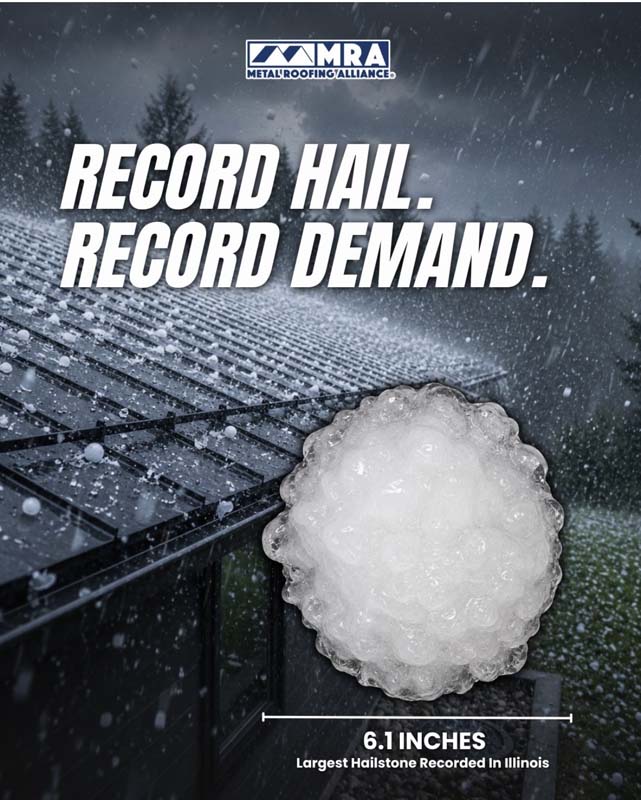
As of early May, Illinois had experienced significantly more hail activity than usual, including a reported 6.1-inch hailstone in March. Other Midwestern and Southern states, including Missouri, Texas, Indiana, and Wisconsin, also have experienced significant hail activity. Nearly 4,000 spring hailstorms had been reported in the United States at that point. In Canada, Alberta continues to experience significant hail activity, with insured losses exceeding $5.5 billion over the past five years. Calgary has been identified as the country’s hailstorm capital.
Hail is a significant source of property damage, and the potential exposure extends well beyond areas traditionally associated with severe weather. An estimated 43.5 million U.S. properties are at moderate or greater risk of hail damage. As severe weather patterns change, roofing contractors may encounter hail-related inspections and repairs in markets where significant hail has not historically been a frequent concern.
For contractors, the roof is one of the building’s primary defenses against hail. Understanding how different roofing materials respond to impact can help when inspecting existing roofs, documenting storm damage, and discussing replacement options with property owners.
Impact resistance is one way to evaluate how a roofing product is expected to perform when subjected to hail. Similar to wind-resistance and fire classifications, roofing products can be tested and assigned an impact-resistance classification.
UL 2218 is one of the commonly recognized standards for evaluating the impact resistance of roofing products. The test, conducted by Underwriters Laboratories, uses steel balls of various sizes dropped from specified heights onto roofing products. Based on the results, products can receive a Class 1, Class 2, Class 3, or Class 4 rating, with Class 4 representing the highest classification.
A Class 4 rating indicates that the roofing product has demonstrated the highest level of impact resistance under the UL 2218 testing protocol. Many metal roofing systems achieve Class 4 ratings, making impact resistance an important consideration when evaluating metal roofing for areas that regularly experience hail.
The performance of an installed roof, however, depends on more than the material itself. Installation practices, substrate conditions, fastening, flashing, seams, penetrations, and other components all contribute to the performance of the completed roofing system. Contractors should therefore consider the entire assembly rather than relying solely on the impact rating of an individual product.
Metal’s characteristics can provide advantages during a hail event. Unlike some brittle roofing materials, metal generally does not crack or fracture from impact in the same manner. Properly installed metal roofing can remain intact following significant impacts, although hail can still leave visible dents or other cosmetic damage depending on the material, profile, thickness, substrate, and severity of the storm.
That distinction between cosmetic and functional damage is particularly important following a hailstorm. A dented metal panel is not necessarily a failed panel. During an inspection, contractors should evaluate whether the impact has compromised seams, fasteners, flashings, penetrations, coatings, or the panel’s ability to perform as designed. Documentation should distinguish visible cosmetic damage from conditions that could affect the roof’s weather resistance or service life.
Roofing professionals also should be cautious when comparing hail performance among different roofing materials. Asphalt shingles, for example, can sustain impact damage that is not immediately obvious. Hail can bruise or fracture shingles, dislodge granules, and compromise the material without producing an obvious opening in the roof covering. A thorough inspection is therefore important even when no interior leakage has been reported.
Metal roofing can experience a different type of hail damage. Depending on the severity of the storm, dents may be visible across the panels while the roofing system remains watertight and functional. Textured finishes and patterned profiles can make minor dents less noticeable, but appearance alone does not determine whether a roof has sustained functional damage.
For contractors inspecting a roof after a hailstorm, the process should begin with a systematic assessment. Document the overall roof condition before focusing on individual impact points. Photograph representative areas as well as significant damage. Inspect panels or shingles, seams, flashings, valleys, penetrations, ridge and eave conditions, and other vulnerable areas. Look for evidence of pre-existing deterioration that may be unrelated to the storm.
Product information can also be valuable. Knowing the roof’s material, thickness, profile, installation date, manufacturer, and impact classification can help provide context for the inspection. Where available, product specifications and installation documentation can help determine what the roofing system was designed to withstand.
Hail damage also reinforces the importance of setting realistic expectations with property owners. No roofing material is completely immune to hail damage. A high impact-resistance rating does not mean a roof will emerge from every hailstorm without dents or other visible effects. Rather, the rating provides information about how the product performed under a defined test procedure.
For roofing contractors, that distinction matters. The goal following a hailstorm should be to accurately assess the condition of the roofing system, identify damage, and determine whether the roof’s performance has been compromised. A careful inspection supported by photographs and product information provides a stronger basis for determining the appropriate next step.
As hail continues to affect large portions of the United States and Canada, impact resistance is likely to remain an important consideration in roofing material selection. For contractors working in hail-prone markets, understanding impact ratings and the differences between cosmetic and functional damage can make post-storm inspections more precise and help property owners make informed decisions about their roofing systems.