Originally Published as: Sealing Roof Penetrations: Keys for Effectiveness and Ease
Resources
- Aztec Washer Company • www.aztecwasher.com
- EPDM Coatings • www.epdmcoatings.com
Every roof will eventually face one universal test: How well does it keep water out around penetrations? Whether it’s a plumbing vent, flue pipe, skylight, or solar mount, the integrity of that joint determines how long the roof performs. Many people reach for a tube of sealant, but seasoned roofers know that flashing is essential; the sealant’s job is to protect and support the flashing, not to take its place.
Flashing Material that Fits the Climate
Not all flashings are created equal, and not every roof or climate calls for the same material. The choice depends on chemistry, environment, and roof type.
Galvanized steel is often used for asphalt-shingled roofs. It’s rigid, durable, and easy to form. The key is coating weight — G-90 galvanizing or better should be used to resist rust. Cheaper, thinner coatings corrode quickly, especially at cut edges. For regions with salt air, chemical exposure, or high rainfall, aluminum, copper, stainless steel, or silicone-based flashings may be better options.
Aluminum flashing is lightweight and corrosion-resistant, making it ideal for retrofits and areas where installers need flexibility. It does, however, react with alkaline materials such as mortar or concrete, so it should be isolated from masonry.
Copper is a popular choice, costly but nearly permanent. It develops a protective patina instead of corroding and is easy to form around chimneys and architectural details. Always use copper or stainless fasteners with it to prevent galvanic corrosion.
Stainless steel is a high-end performer for coastal and industrial environments. It’s impervious to acid rain, salt, and thermal fatigue, and it lasts for decades when properly integrated into a roof system.
Flexible polymer and rubber flashings, made from EPDM, PVC, or butyl-based compounds, serve well for irregular shapes or areas subject to vibration or movement. They expand, contract, and seal without cracking, making them ideal beneath solar mounts or HVAC supports. UV-rated products are essential, but some low-cost plastics and PVC can become brittle in sunlight.
Silicone-based flashings are often one-piece, form-in-place or pre-molded systems made from cured silicone rubber. They adhere exceptionally well to metal, asphalt, and composite surfaces, tolerate extreme temperatures, and remain flexible for decades. Because silicone is naturally UV- and ozone-resistant, these flashings are particularly suited to high-sun or desert climates where other elastomers degrade. They can also bridge expansion joints and irregular penetrations without needing additional sealant. However, not all roofing adhesives bond to cured silicone, so installers should use compatible silicone sealants or mechanical retention where needed.
Matching Flashing to Roof Materials
Flashing must complement the roofing system. Asphalt shingles rely on step and counter-flashings that follow the same direction as water flow — each shingle course covering the upper edge of the flashing below to keep water moving outward.
Asphalt shingle roofs rely on a layered flashing system that mimics the overlapping pattern of the shingles themselves. Each piece must be lapped in the direction of water flow.
- Step flashing is used where the roof meets vertical walls or dormers. Each small piece is installed with a single shingle course, creating a stair-step pattern that channels runoff outward.
- Apron flashing is used at roof-to-wall transitions, while counter-flashing covers the top edge to prevent water entry.
- Pipe boots or vent flashings must sit on top of the lower shingles and under the upper course to maintain the water-shedding plane.
Use galvanized steel, aluminum, or copper, depending on environment, but ensure the metal is corrosion-resistant and matches the surrounding materials. On low-slope shingle roofs, it’s wise to extend an ice-and-water membrane beneath flashing zones for added backup.
Asphalt roofing (roll roofing, modified bitumen, or built-up systems) include flat or low-slope asphalt roofs and flashing becomes part of the membrane itself rather than a separate metal piece.
- Use reinforced bitumen or liquid-applied flashings that chemically bond with the field membrane.
- In multi-ply systems, each layer is stepped up the penetration, creating a watertight “boot” embedded in asphalt adhesive or heat-welded seams.
- Counter-flashing (metal or aluminum) is often installed at the termination point to protect the top edge from UV exposure.
For vent stacks or curbs, flexible metal flashings or formable lead can be integrated into the hot-applied system. Avoid standard shingle-style metal flashings — they can’t flex or bond properly in a low-slope environment.
Composite shingles created of recycled plastic, rubber, fiberglass, or blends) expand and contract differently than asphalt, so flexibility and chemical compatibility are crucial. Avoid asphalt-based adhesives or coatings unless the shingle manufacturer explicitly approves them. Use coated steel or polymeric flashings that tolerate movement. Silicone or EPDM boots perform especially well for pipe and vent penetrations because they flex with temperature swings and won’t become brittle. Always consult the shingle manufacturer’s installation guide to confirm which metals and sealants are acceptable — many composite shingle warranties specify compatible flashing materials.
Metal panels require high-temperature tolerant, UV-stable flashings and sealants designed for thermal movement. Flexible EPDM or silicone pipe boots with adjustable, ribbed collars are standard, secured with screws through the upper flange and sealed with compatible butyl tape beneath.
For standing seam or concealed-fastener systems, specialized retrofit flashings clamp to seams rather than penetrating panels, maintaining the weathertight integrity. High-temp underlayment beneath all penetrations is essential to prevent bleed-out and protect against expansion fatigue.
Concrete and clay tile roofs demand a two-part flashing system: base flashing below the tile and counter-flashing above. The challenge here is the tile’s irregular surface, which can trap water if flashing is too flat.
- Pan-style or channel flashings are used beneath tiles to direct runoff down the underlayment plane.
- Headwall and sidewall flashings are elevated to match the tile contour and must integrate into the tile course pattern.
- At ridges or valleys, special formed metal flashings (often aluminum or copper) are shaped to fit under tile edges, with weep holes for ventilation and drainage.
- Sealant is used sparingly — mainly on fastener heads or where the metal meets masonry. Never rely on caulk alone to fill tile gaps; the flashing geometry should do the work.
In high-wind zones, heavier-gauge metals and mechanical fastening are critical. Flexible flashings such as lead or malleable aluminum are preferred because they can be hand-shaped to conform to the tile profile and maintain watertightness over time.
Proper Flashing Installation and Layering
Good flashing installation follows this rule: water must always run over the layers, never into them. The sequence is nonnegotiable — underlayment first, then flashing, then shingles, and finally sealant if needed. The underlayment should lap over the lower edge of the flashing, while the shingles cover its upper flange.
At roof-to-wall intersections, step flashing pieces should overlap by at least 2 inches, with each new course integrated into the shingle layer. The vertical leg of the flashing should rise at least 4 inches — more in heavy-snow or high-rainfall regions. Counter-flashing protects the upper edge and prevents backflow.
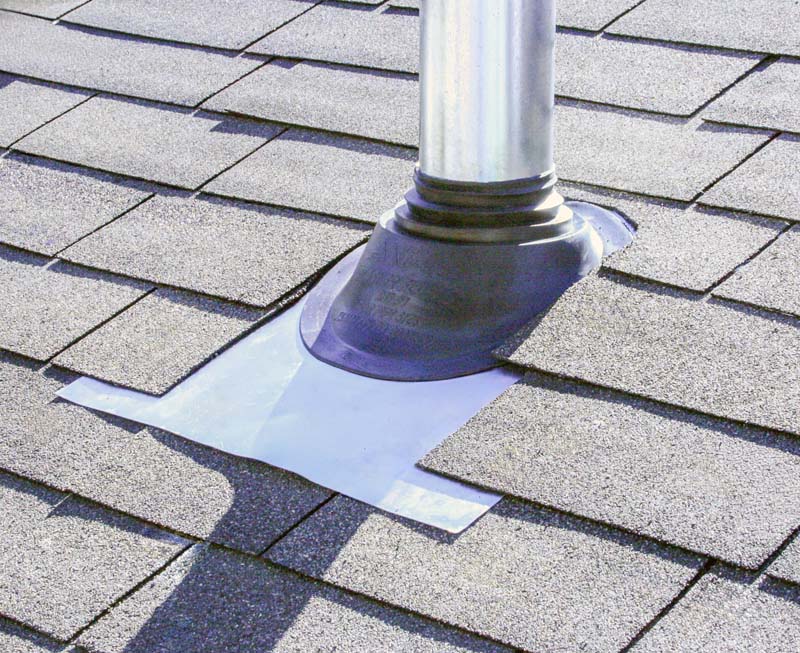
Pipe penetrations and vents require factory-formed or pre-molded boots that fit snugly. Silicone or EPDM boots work especially well because they flex with movement and temperature changes. The base flange must rest flat, with fasteners only on the upper portion so water cannot track through nail holes. Never rely on a thick bead of caulk as a permanent solution.
Flashing Design for Complex or Irregular Areas
When penetrations occur near ridges, valleys, or seams, layout matters. Avoid placing penetrations directly in valleys where runoff concentrates. If unavoidable, install an ice-and-water shield beneath and extend it several inches upslope and to each side. Flashing pieces should then be layered to guide runoff around, not into, the intersection.
For irregular or custom mounts such as solar racks or HVAC supports, use a two-part system: flexible base flashing (silicone, EPDM, or butyl) beneath the shingles and rigid counter-flashing above. This combination absorbs motion while maintaining a positive water path. For large obstructions, use saddles or crickets to divert water around them — the hallmark of a professional install.
Common Flashing Errors
Flashing failures rarely stem from defective materials. The culprits are almost always installation shortcuts:
- Fastening through the wrong plane — for instance, through a vertical face where expansion opens the hole.
- Reverse layering that channels water behind the flashing.
- Mixed metals causing galvanic corrosion.
- Flattened or under-bent flashing that loses its drainage slope.
And the most persistent error: using sealant to make up for poor fit or alignment. Once thermal movement begins, the sealant shears and the leak begins.
Sealants: The Supporting Player
Sealants have an important though limited role — sealing small gaps, fastener heads, or vertical seams where flashing geometry can’t do the job alone. Ensure that the sealant type is compatible with roofing material.
Durability and Maintenance
Sealant and flashing performance both depend on environment. Sunlight, heat cycling, standing water, and freeze-thaw cycles shorten service life. In sun-intense climates, even high-end polyurethanes age faster than the surrounding flashing; silicone products tend to outlast them.
Routine inspection once a year is good practice. Advise your customers to look for cracking, separation, or corrosion, then reseal as needed — typically every five to ten years for polyurethane or hybrid products, and every decade or more for silicone systems. Roofs that drain well and stay clean need less attention; shaded or flat areas need more.
Putting It All Together
A watertight penetration isn’t about how much caulk you use; it’s about how intelligently the system is layered. The flashing forms the armor, the underlayment is the shield beneath it, and the sealant fills only the smallest of gaps.
When materials are compatible and sequencing is correct, penetrations can remain watertight for the life of the roof. Choose your flashing material to match your climate and roof chemistry, your sealant to match your flashing, and inspect regularly. Done right, these details turn a roof’s weakest points into reliable defenses.
Pipe Flashings That Move with the Roof
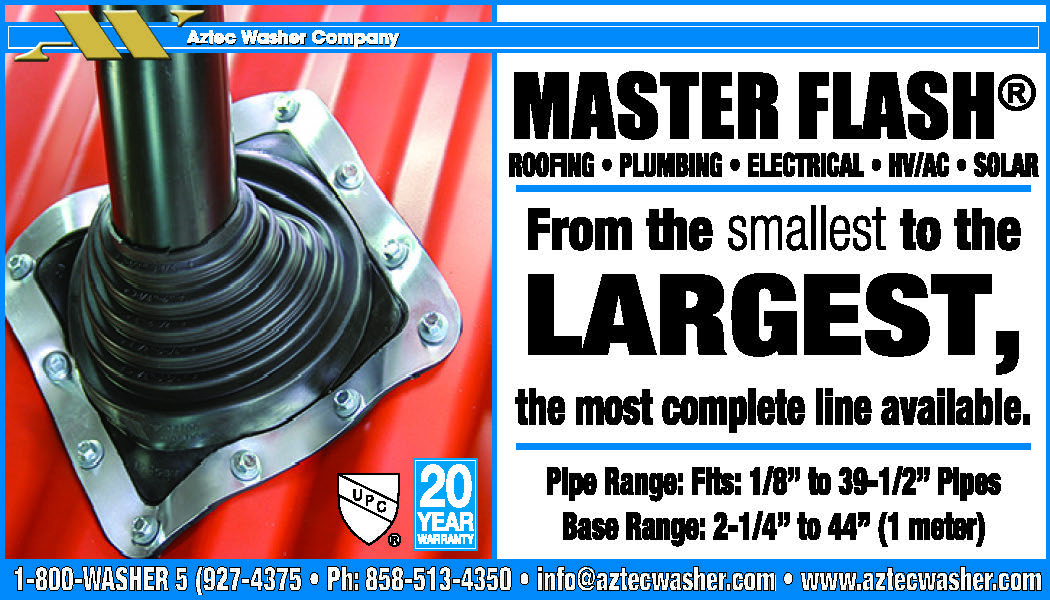
Aztec Washers’ Master Flash line is built around EPDM and silicone boots with malleable aluminum bases that conform to most roof profiles. Vice President of Sales Juan Roman said, “The flashing is engineered to move with vibration, thermal expansion, and contraction.”
EPDM is ozone-resistant and rated for continuous service up to 212°F, which covers most applications on residential and light commercial roofs. For hotter stacks and appliances, Aztec specifies silicone boots, which Roman notes “handle sustained high heat—think desert installs.” The company cites cold-weather durability to -50°F. Master Flash carries a 25-year flashing warranty.
The boots are common on plumbing vents, HVAC and furnace penetrations, wood-burning stove pipes, chimneys, and increasingly solar racking posts. Roman says the aluminum base “is very shapeable, so crews can adapt it to metal panels, shingles, and even many tile and composite profiles. On low-slope membranes (EPDM, TPO, PVC), check the roof manufacturer’s details first; the roof flashing is likely compatible, but “don’t jeopardize a system warranty without confirmation.”
Roman said, “A bead of silicone around a boot by itself isn’t a long-term seal. The compression fit of these boots does the sealing; the chemistry just supports it.” On asphalt, composite, and concrete/tile, use a polyurethane under the base to adhere the flashing and block capillary paths. Avoid petrochemical adhesives or foams; vibration and UV can crack those and invite leaks. Any sealant used should be buried under the flange, not exposed to the sun.
Most installation errors start at the snip. “Don’t cut the cone to the pipe’s exact dimensions,” Roman said. “Cut the opening about 10-25% smaller and stretch the boot down like a sleeve. That compression is your primary seal.” Slide the base under the upslope shingle/course, fasten in the upper portion of the flange, and let water shed over the lower edge.
Aztec has continuous R&D on flashing materials. One outcome is a FireBlock formulation, developed for wildfire-prone regions and tested to 1000°F, now proven in the Australian market.
Aftermarket Penetration Repairs
EPDM Coating (liquid butyl rubber) is the only product of its kind — a true liquid butyl rubber that adheres to nearly anything except PVC or silicone. It bonds directly to any roof type as well as other third party coatings that were already applied.
Greg Kazmierczak, Sr. Vice President of Sales at EPDM Coatings said, “While our Liquid Butyl Rubber isn’t intended for new construction, it excels at aftermarket repairs around roof penetrations, seams, and flashing transitions. When used with Seam-Tite, a high-build butyl rubber coating with a thick, honey-like consistency, the system can extend roof life by 18–20 years. Seam-Tite can even be applied over mild to moderate rust, acting as its own inhibitor, though heavy corrosion should be brushed and treated first.”
Kazmierczak shared this application tip: “Brush Seam-Tite along the seam, embed polyester fabric into it, and coat again to “sandwich” the reinforcement. Once cured, it resists weathering, expansion, and contraction so effectively that only catastrophic events — like a tornado — are likely to tear it apart.”
Great tensile strength and 500% elongation make EPDM ideal where metal expansion and contraction are issues . It can be used on roofs regardless of slope, including large flat roofs and industrial cooling towers. This material can handle temperatures as low as -50°F while maintaining its elasticity and it is resistant to UV radiation and ozone exposure while handling temperatures as high as 250°F.
Roof maintenance should include inspections of seams and penetrations twice yearly, clearing debris, and photographing possible problem areas for later comparison.
The bottom line is that Liquid Butyl Rubber and Seam-Tite can greatly extend roof life sealing difficult penetrations, but they’re not “do-everything” solutions. The key is compatibility, correct thickness, and consistent inspection. Together they present a cost-effective alternative to roof replacement.
![Recycling Low-Slope Asphalt Roofing: Creating Value Beyond the Roof [ARMA Report]](https://roofingelementsmagazine.com/wp-content/uploads/2026/06/ARMA-logo.jpg)