Originally Published as: Certifications & Real World Performance: A Plain-Language Guide to Roofing Tests, Standards, and Weather Resilience
Andrew Wilson serves as Chief Engineering & Innovation Officer for Central States Inc., overseeing product development, testing and certifications, engineering and the Project Management Office. He has served in a variety of leadership roles in the past, including supply chain and operations. He brings decades of experience working in manufacturing businesses, specializing in continuous improvement and quality management. Andrew serves on committees for several major industry associations, including the Metal Construction Alliance and the Cool Roof Rating Council.
When homeowners or builders think about roof performance, one big question frequently comes up: Do industry certifications actually mean a roof will perform better in the real world? The short answer – especially for metal roofing, is yes, but with some important context.
To understand why, it helps to decode what roofing certifications really measure, how they’re tested, and how insurance and building science groups interpret those results.
Why Standards Exist in the First Place
Industry standards exist for a simple reason: protecting consumers. Roofing manufacturers must prove that their products meet industry agreed-upon levels of performance and resilience against wind, fire, impact, and other short and longterm exposures. Third party groups like UL, ASTM, FM Global, and others establish standard criteria and test products against those standards so consumers can have confidence that products meet an industry agreed-upon standard of performance.
Breaking Down the Major Tests (in language we all understand)
As builders and contractors in the industry, many professionals are familiar with the names of common industry standards and certifications but understanding what each of those certifications mean and how products earn the rating is less common. Below is a simplified guide to the tests most commonly referenced in roofing certifications.
1. UL 2218 –Impact Resistance
What it tests: A steel ball is repeatedly dropped from a height, striking the same roofing surface multiple times. Materials are then inspected for cracking or punctures. The larger the steel ball and the higher the height the ball is dropped from, the higher the impact rating, with 1 being the least impact resistant and 4 being the most impact resistant.
Why it matters: UL 2218 has become the industry standard certification for impact ratings, even being written into building codes in some areas, requiring all new roof installations to bear the Class 4 rating. The test and rating are typically thought of as a measure of the roof’s hail resistance, but test standards are clear that the rating is for impacts, not specifically hail as the shape, speed, and density of hail stones impact roofs in unique ways that do not directly correlate to a falling steel ball. Hail causes more than $1.5 billion in annual U.S. roof damage, and larger hail is becoming more common.
Metal typically earns Class 4 because its rigid substrate and coatings absorb and disperse energy better than fiberglass asphalt materials.
2. ASTM E1592 / UL 580 – Wind Uplift
What it tests: Both tests simulate wind pressure trying to pull a roof off a structure, the UL test is for general roof assemblies and the ASTM test is specific to metal roof and wall systems. In both tests, a full roof assembly is mounted in a pressure chamber and air pressure is applied from below in increasing gusts until the system fails or reaches a specific load. The results show the maximum uplift pressure the roof system can withstand and help determine whether it meets building code and design requirements for wind resistance.
Why it matters: Tornadoes and hurricanes can generate wind gusts exceeding 200 mph. Well-designed metal roof systems are commonly engineered to withstand 120–150 mph winds (typical hurricane design ranges). High-performance, tested systems can handle 150–180+ mph winds when properly installed. Some standing seam metal roofs, tested to standards like UL 580 or ASTM E1592, are rated for wind uplift pressures equivalent to Category 4–5 hurricane conditions.
Fastener design, panel strength, and installation quality greatly affect performance which are areas where metal roofs excel because of interlocking designs and screwfastened systems.
3. UL 790 / ASTM E108 – Fire Resistance
What it tests: These equivalent tests are used to evaluate fire resistance of roof coverings when exposed to external fire sources like wind-blown embers or nearby flames. The tests measure how the roof covering performs under three main fire-exposure scenarios:
- Intermittent Flame Test – Simulates flames repeatedly contacting the roof surface, like from burning debris.
- Spread of Flame Test – Evaluates how far and how fast flames travel across the roof surface.
- Burning Brand Test – Places a burning material (brand) on the roof to see if it ignites or penetrates the assembly.
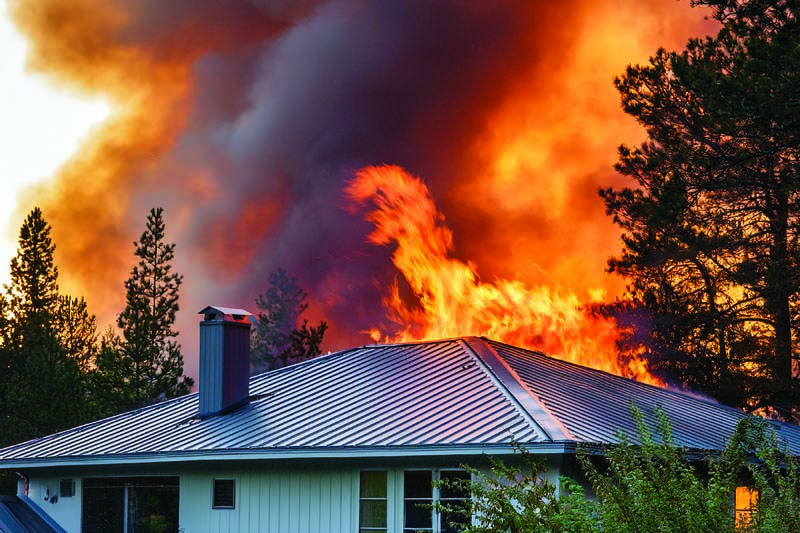
Roof materials and systems earn ratings based on how long they can resist the fire’s spread or penetration Class A roof, the highest rating, resists fire spread for up to four hours. Metal roofing is naturally noncombustible and regularly earns Class A ratings.
Why it matters: More than 4.8 million U.S. homes are in high-risk wildfire zones.
Metal’s natural resistance to ignition provides meaningful protection.
4. FM Global 4471 – Commercial Wind, Fire, and Impact Performance
What it tests: This comprehensive test standard evaluates a complete roof system (deck, insulation, fasteners, and roof covering) for its performance against fire, wind uplift, and impact resistance under insurance-industry standards.
- Wind uplift resistance – The assembly is subjected to increasing air pressure to simulate strong winds trying to lift the roof off the building.
- Fire resistance – The roof is exposed to external fire sources to evaluate flame spread and fire penetration.
- Hail resistance – The roof covering is impacted with steel balls and examined for cracks or perforations.
- Based on performance, roof systems receive specific FM approvals and ratings, such as:
- Wind uplift ratings (e.g., 1-60, 1-90, 1-120)
- Hail resistance ratings (e.g., Moderate or Severe Hail)
Why it matters: FM 4471 approval indicates the roof system has been tested as a complete assembly and can provide a high level of protection against severe weather and fire, helping reduce property loss and insurance risk. FM Global is an insurance engineering authority. Their “FM APPROVED” mark is trusted by commercial builders and often required for coverage. Tests are rigorous, including ongoing audits – not just a onetime lab qualification.
Do These Certifications Predict Real World Resilience?
Understanding how each of these industry certifications are conducted leads to the question: do these very controlled tests actually translate to real-world performance? The answer: it depends.
For some materials and some tests, the connection between test performance and real-world performance is strongly correlated. For others, not as much. And understanding exactly how the tests are conducted and what they are testing can also help set better expectations for consumers about performance expectations. For example, a roof can achieve a Class 4 impact rating in a testing facility, and successfully not puncture or crack during a hailstorm, but still suffer granule loss that will eventually lead to premature shingle aging or have significant cosmetic damage from the hail.
Similarly, roof assemblies may test well for extremely high wind speeds, but in real-world scenarios, failure often occurs based on the underlying structure. And fire-resistant certifications don’t equate to fireproof materials. Most materials will eventually succumb to fire if exposed for long enough.
But, unlike many other roof materials, the simple, innate qualities of metal are more likely to deliver real-world performance that is consistent with the test results, giving consumers confidence in the material.
Metal Roofing as the Hero of Real World Performance
Across almost every major test category—hail, wind, fire, water infiltration—metal roofing consistently scores among the highest performers. And unlike materials that degrade over time, metal maintains much of its tested performance decades into its lifespan.
Central States, along with other manufacturers in the industry, contributes to these outcomes by meeting rigorous standards, earning certifications like FM Global 4471, and participating in advanced testing. But the real story is broader:
Metal roofing as a category stands out as one of the most storm-resilient, long-lasting, and safety-enhancing roofing solutions available today.