Originally Published as: Fire Performance: Fire is one of the most serious threats facing commercial facilities today, and optimal roofing materials can help stave off flame spread. Here’s how to evaluate your roof for fire performance.

Ryan Van Wert is the Technical Services Manager for Seaman Corporation’s FiberTite Roof Systems (www.fibertite.com). He has been in the commercial roofing industry since 2017, following a career in structural design. He holds a master’s degree in civil engineering, with a focus on structural engineering, from Norwich University and a bachelor’s degree in construction management from Central Michigan University. Ryan has extensive experience in the construction industry, including expertise in building inspections, mold inspections and energy audits, bringing a broad range of technical capabilities to his role.
Commercial buildings—often home to critical operations for businesses everywhere—face constant exposure to environmental threats. Among them, fire remains one of the most destructive and difficult to predict.
Across the United States, rooftop fires are an increasing concern1, driven by factors ranging from severe weather events and nearby wildfires to electrical failures and equipment. While many facility managers focus fire protection efforts on interior systems, one of the most effective opportunities to limit flame spread begins above it all: the roof.
Today’s commercial building owners have more roofing options than ever before—but not all roof systems perform the same when exposed to fire. Material composition, system design and fire testing standards all play a role in determining how a roof will respond in real-world fire conditions. This article examines common exterior fire threats, how commercial roofing systems are evaluated for fire performance, and why material selection can make a critical difference when it matters most.
Common Exterior Fire Threats to Commercial Roofs
Many of the most common fire threats to commercial roofs originate not from extraordinary events, but from routine building systems and conditions that exist on nearly every facility, including:
- Exhaust systems. Commercial and industrial exhaust systems often rely on ductwork that penetrates the roof assembly. Mechanical or operational failures can create ignition sources, while discharged contaminants may increase fire risk at the roof surface. For example, commercial kitchen exhaust systems can deposit flammable fats or oils onto roofing materials.
- Electrical systems. Rooftops commonly house electrical equipment such as HVAC units and rooftop solar panels. Electrical failures—including arc faults, ground faults and short circuits—can serve as ignition sources, particularly when combined with combustible roof components or accumulated debris.
- Severe weather events. Certain weather-related events can introduce fire risk to commercial roofs. Lightning strikes during severe storms may directly ignite rooftop materials, while nearby wildfires can generate wind-borne embers. Even when a facility is outside the immediate fire zone, embers landing on the roof can initiate ignition.
- Maintenance and repair. Routine maintenance and repair work can unintentionally introduce fire hazards. Hot work, such as arc welding or cutting, may produce sparks or molten metal, while construction trades working on adjacent building systems during installation or renovation can increase the likelihood of accidental ignition.
- Excessive debris.Debris buildup on a rooftop can act as fuel during a fire event, even if it is not the initial ignition source. Materials such as dead leaves can ignite quickly, accelerating flame spread and increasing overall fire severity.
Risks Associated With Commercial Rooftop Fires
Commercial rooftop fires pose a few different risks than interior building fires, since commercial roofs typically lack fire detection mechanisms. This means that a fire may go unnoticed and has the chance to spread, slowing fire department response and increasing potential consequences. Rooftops are also not typically equipped with automatic sprinkler systems that can quench flames. Further, wind can accelerate the spread of fire across a roof’s surface.
Rooftop fires also pose unique challenges for emergency responders. Firefighters must access the roof by climbing the structure, and in severe cases, rapid flame spread can compromise structural integrity, leading to risk of collapse and forcing response from a distance.
These are all reasons to remain vigilant about minimizing rooftop fire risk. Facility managers and building owners can enhance the fire readiness of commercial properties by choosing a roof system that demonstrates proven performance under fire.
Examining Common Testing Standards for Fire Performance
Two primary test methods are used to evaluate commercial roof systems under fire conditions originating outside the building: ASTM E108 and UL 790. Both test methods are referenced in the International Building Code (IBC), and both involve three primary fire tests:
- Intermittent Flame test. This test evaluates the resistance of the roof covering when exposed to intermittent fire conditions. It is required if the roof is installed on a combustible deck.
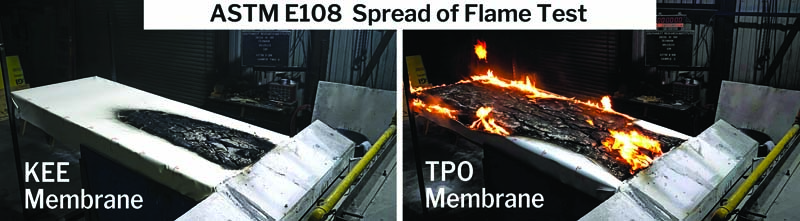
- Spread of Flame test. This test simulates burning embers that have landed on the roof and is required for both combustible and noncombustible decks.
- Burning Brand test. This test determines the roof’s ability to resist ignition, fire spread and burn-through. The test is performed by placing a burning brand on the surface of the roof covering and is required for combustible decks.
- Based on a roof material’s performance under these testing materials, a roof system may be classified under one of three categories:
- Class A is the highest fire-resistance rating. A Class A rating is typically a requirement for buildings that may be more at risk for fires or governed by local building codes (for example, a building located in a wildfire zone). Class A systems have been shown to withstand severe fire exposure, offer a high degree of fire protection to the roof deck and do not pose a flying brand hazard.
- Class B exhibits moderate fire performance, resisting flame spread up to 8 feet over the designated test time. This rating is applicable to roof coverings expected to stand up to moderate fire exposure. Similar to Class A roof systems, those rated as Class B should not present a flying brand hazard.
- Class C designates limited protection against fire. The roof system must resist flame spread up to 13 feet over the designated test time. This classification is intended for light fire exposure, offers minimal fire protection for the roof deck and provides no flying brand hazard.
Roofs rated Class A can be assumed to represent the highest level of protection available—however, despite its stringency, this rating does not necessarily tell the full story of fire performance. Consider that ASTM E108 and UL 790 testing protocols evaluate roof systems as complete assemblies, which include the membrane, insulation, fasteners and other components, each of which can contribute to differing performance under real-world conditions. And even with a Class A rating, there is no requirement that the system not burn—only that it burns slowly enough to limit flame spread within a desired distance during the test duration.
The truth is that material composition can make a significant difference in the event of a real fire. For example, single-ply roof membranes typically used in commercial roof systems are made from a variety of different membranes, including thermoplastic polyolefin (TPO), ethylene propylene diene monomer (EPDM), polyvinyl chloride (PVC) or ketone ethylene ester (KEE). These materials do not all demonstrate comparable fire performance—in fact, some may contribute to flame spread more than others.
Consider TPO. It is a common choice due to its low initial cost, but inherent fire performance is lacking. Independent testing results involving ASTM E108 have shown that TPO membranes can contribute to significant flame spread across a roof. Elsewhere, in an NFPA 701 vertical burn test, one TPO specimen, approximately 5 inches wide by 48 inches tall, exhibited melting and dripping behavior while burning for more than 38 minutes before fully consuming the sample itself.
Conversely, some high-performance roof membranes have demonstrated self-extinguishing properties in similar burn tests and are also proven to minimize flame spread and damage severity in similar roof system tests, supporting increased operational security and risk mitigation. KEE roofs, for example, do not sustain flames, helping to limit fire spread across the roof. In terms of ignition resistance and flame spread, KEE is the top performer among single-ply membranes, whereas EPDM and TPO rely more on system design to meet high fire ratings.
Conclusion
Ultimately, commercial rooftop fires have the potential to wreak havoc on buildings everywhere, and building owners, operators and roofing professionals should seek to minimize the risks. Selecting and specifying high-performance roof materials that can minimize flame spread in the event of a fire can be an effective means to best prepare commercial building envelopes—it can make a major difference.
TPO vs. KEE: Real-World Performance
A recent case study illustrates the performance differences between TPO and KEE. Prolec® GE Waukesha, a prominent power transformer manufacturer supporting critical electrical infrastructure, experienced it firsthand on the evening of Feb. 11, 2023.
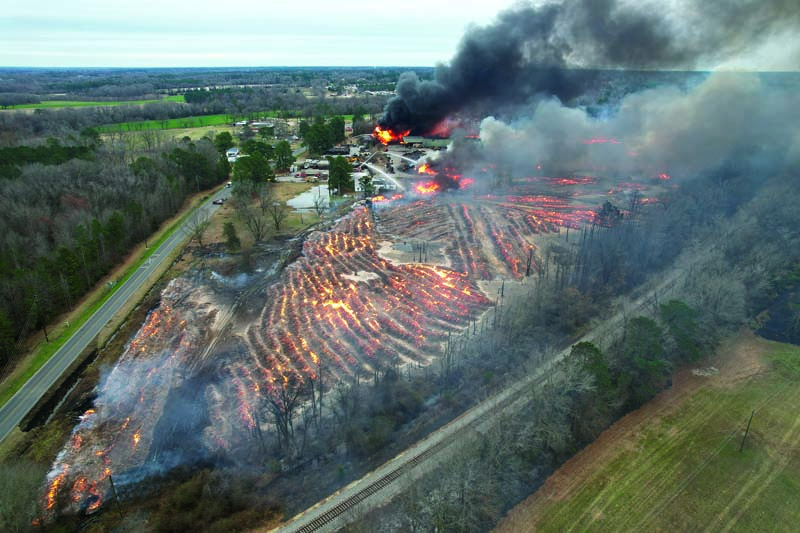
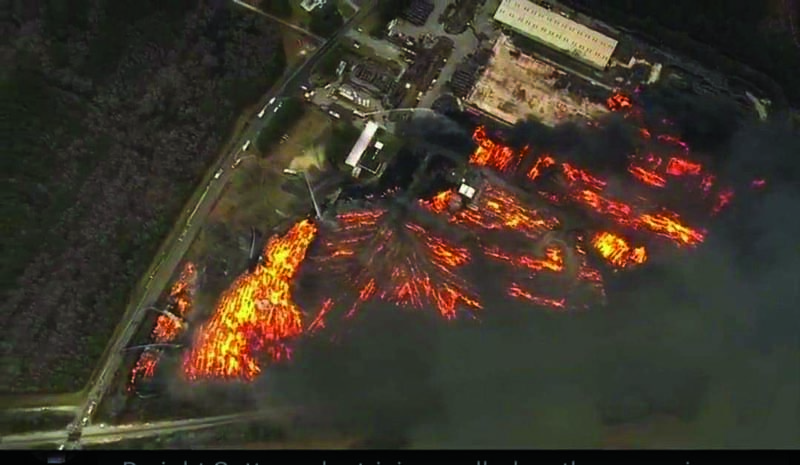
That night, a fire broke out at an industrial salvage yard near the company’s Goldsboro, North Carolina, facility. The salvage yard housed thousands of wooden railroad ties across more than 20 acres. The ties had been coated with creosote for preservation—and once a fire broke out, this flammable coating accelerated the blaze. As flames intensified, embers launched into the air, many of them landing on the Prolec GE facility rooftop. Portions of the roof included both TPO and a KEE-based roof system (in this case, a FiberTite® roof system).
More than 150 burn holes developed in the TPO section; the KEE portion, by contrast, remained intact. Twenty to 30 soot marks were evident and showed no penetration of the KEE membrane, attributable to the membrane’s self-extinguishing properties. Following cleaning and inspection, the KEE portion maintained its full manufacturer’s warranty, while the TPO portion of the roof required full replacement.